Showing posts with label History. Show all posts

Tuesday, January 8, 2019

John Marshall by Richard Brookhiser


John Marshall is one of the most consequential figures in the history of the United States, yet too little is known about him. In John Marshall : The Man Who Made The Supreme Court, journalist and author Richard Brookhiser seeks to help us know more about this man. In life Marshall was an unimposing character. Early in the book Brookhiser relates a story about Marshall at home in Richmond. He was dressed like any other rustic. A newcomer to town asked him to carry a turkey home from the market, not realizing until afterwards that he had used the Chief Justice of the Supreme Court as a delivery man. Marshall was a man of humor.  Brookhiser shares another anecdote in the book. The Justices would board in the same house when the Court was in session and they ate together. They established a custom that they could only have wine if it was raining. “Marshall would ask ‘Brother Story’ [Justice Joseph Story] to look out the window and say what the weather was. If Story reported that the sun was shining, Marshall would answer, ‘our jurisdiction extends over so large a territory…that it must be raining somewhere.’” 

These anecdotes help to remind us that Marshall was an approachable and affable man. That did not make him weak. In his Introduction Brookhiser points out that “When Marshall died in 1835, he and the Court he led had rebuked two presidents, Congress, and a dozen states and laid down principles of law and politics that still apply.” That, of course, is why we know Marshall. He was the man who turned the Supreme Court into a powerful part of the United States government. Before Marshall the Supreme Court had little influence on the nation. After Marshall the influence was powerful.

The book is well written and easily approachable by the general reader. Brookhiser is a journalist by training and profession so he does not get into the weeds of trying to explain all of the minutiae behind the laws. Instead he focuses on the political implications of Marshall’s rulings. This is important because when Marshall established the idea of judicial oversight he inserted the Court into the politics of the new nation. Marshall was well aware that he was helping to guide the nation forward. He was a Revolutionary War veteran who had served on Washington’s staff.  As a young member of the Virginia Ratifying Convention he fought hard alongside James Madison for the ratification of the Constitution.  He was a successful attorney in private practice before moving into the government. He served under John Adams as Secretary of State before he became the third Chief Justice. Brookhiser takes us through his early years without succumbing that siren call of the historian: the rabbit trail. So many writers feel a need to set up a history by giving huge back stories or going off into minute detail about some side issue. Brookhiser deftly gives us what we need to understand the subject and keeps moving.

This is an excellent book and does justice to the subject. It also delivers the reader a well written, informative, and enjoyable experience.


Saturday, November 17, 2018

Mortal Republic by Edward Watts

Popular histories of the fall of the Roman Republic are not in short supply. There are excellent entries in this crowded field. One can look to Tom Holland’s Rubicon or the recent New York Times bestseller The Storm Before the Storm by popular podcaster Mike Duncan. Into this crowded field we have Mortal Republicby Edward J. Watts.  Dr. Watts is Professor of History at the University of California, San Diego. His previous works have focused on the period of late antiquity and the clashes between pagan and Christian culture. In his newest work Dr. Watts examines the forces that brought about the end of the Roman Republic. 

This book does not start, as is common, with the rise of the Gracchi brothers. Those radical reformers whose lives and deaths plunged the Republic into short periods of chaos. Instead he begins in 280 BC, with the wars between Rome and the Greek King Pyrrhus. Why this period? He wants to show the nature of the Roman leaders in this period. Roman leadership was a duty that was held by men who held honor above wealth.

This is an important point that will be seen throughout this book. In the early days of the Republic the nobles of Rome “agreed that virtue lay in service to Rome and that dishonor fell upon those who put their private interests above those of the Republic.” This noble ideal would become stressed as the Roman Republic grow in size, power and wealth. The change can be seen as the Romans fight the Carthaginians for control of Sicily. The Punic Wars spread Roman power abroad and soon the Republic had foreign territories to manage. With those territories came officials needed to run them. Those officials tended to become wealthy in those jobs. That wealth became the new motive for public service. Now honor gave way to avarice. As the quest for wealth and glory became the prime motivator factions began to arrive. Those factions would eventually wear away at the fabric of the Republic until it frayed and crumbled.

This did not happen in one lifetime. It took almost two centuries for the ethics and values of the Romans to devolve to the place where strong men like Sulla, Marius, Pompey, and Caesar could tear it apart. The great weakness in the Roman system was the reliance on personal honor to maintain itself. Tradition and honor were no defense against personal ambition and tremendous wealth.

The book is written for the general reader. One does not need a specialized background in Roman history to understand. The topic is indeed timely. In the Preface to the book Dr. Watts hopes “that this book allows its readers to better appreciate the serious problems that result both from politicians who breach a republic’s political norms and from citizens who choose not to punish them for doing so.” That is as far as he goes in trying to connect the past and the present. It is up to the readers to notice the signs and to take warning. 

The book ends as did the Republic: with the reign of Augustus. For over half a century the Republic had been torn by one faction after another competing for power. What are we supposed to gather from this book? Why read another book on the fall of a government that fell 2,000 years ago? Because the freedoms and laws of a republic must continually be upheld and protected.  Ronald Reagan famously said “Freedom is never more than one generation away from extinction.” Perhaps the closing statement of the book sums it up best. “When citizens take the health and durability of their republic for granted, that republic is at risk. This was as true in 133 BC or 82 BC or 44 BC as it is in AD 2018. In ancient Rome and in the modern world, a republic is a thing to be cherished, protected, and respected. If it falls, an uncertain, dangerous, and destructive future lies on the other side.”


Tuesday, October 10, 2017

John Marshall by Harlow Giles Unger

John Marshall: The Chief Justice Who Saved The Nation
Harlow Giles Unger
Da Capo Press, 2014

John Marshall is one of the most important figures in American History, yet so few people know anything about him. Born in a log cabin in what was then the western frontier of the colony of Virginia he would rise until he became the Chief Justice of the Supreme Court. Marshall was far more than a mere Chief Justice. During his tenure on the court from 1801 – 1835 he would reinvent the Court and make it the powerful institution that it is today. In Marbury v. Madison, Marshall would assert the power of the Court to determine the constitutionality of a law passed by Congress. This particular duty of the Supreme Court is so taken for granted today that we forget how controversial it was at the time. President Thomas Jefferson, who did not want an independent judiciary, did his best to undermine and destroy the power of the Court. The Speaker of the House was a staunch Jefferson supporter and led the charge to impeach Samuel Chase, one of the Justices. The hope was to impeach and remove the judges who disagreed with Jefferson one by one until the Court was packed with Jefferson supporters who would then undermine the power of the Court. The trial of Justice Chase came back with a “not guilty” verdict and Jefferson was handed a strong defeat. After this Marshall and the Court would go on to carve out and define the power of the Court and establish precedents that exist to this day.


Florence King once referred to Harlow Giles Unger as “America’s most readable historian.” John Marshall proves once again that Mr. Unger has not lost any of those skills. This volume is not a reference heavy tome meant for the professional historian. It is an excellent introduction to both John Marshall and his world. You do not need any outside knowledge to understand this book and what is going on throughout this time period. Unger does not delve deeply into the side characters so if you want to know more about men like James Monroe, James Madison, and others then you will need to read about them. Fortunately, there are many excellent books on those sources. Unger is dedicated to his own subject and he does not fall prey to that Siren song that so often entraps the historian: the rabbit trail. This book is recommended for anyone who would like to know more about the history of the United States and the foundation period when so much that we take for granted today came about. Marshall is a fascinating subject and Unger brings him to life. We see the man willing to disappoint President Washington and turn down important government posts because of family duties. We see a man willing to stand up to Thomas Jefferson and fight for the right to an independent judiciary. Captain, Congressman, Secretary of State, Chief Justice of the Supreme Court are all official titles that he held from the period of the Revolution until his death in 1835. Those who knew him knew him as a son, husband, father, friend, patriot, a tireless worker for the new Union. Harlow Giles Unger shows us all of these aspects and gives us John Marshall.

Tuesday, January 6, 2015

Double Agent by Peter Duffy

Double Agent is the true story of Nazi espionage in pre-war America and the German-American who helped to bring it down. During a visit to his native German a young William Sebold was coerced into becoming a Nazi spy. He was trained and returned to the United States to carry out his mission. His first act was to contact the US authorities and alert them to what was happening. He then agreed to serve as a double agent and to help bring down the spy ring. The book centers around the colorful cast of characters. Sebold, an adventurer with a nervous disposition, is the unlikely hero of the story. Among the colorful cast of characters is a South African adventurer, a Jewish socialite who escaped the Nazis by becoming a seductress of important figures, and a host of others who either sympathized with the Nazis or had a strong dislike for the British. The investigation would lead to the largest arrest of foreign agents as of that date. The trial of these agents would coincide with the bombing of Pearl Harbor and the entrance of the United States into the Second World War. These agents could have caused serious damage to the US war efforts, particularly in shipping. Instead they were in prison and unable to accomplish their goals.
Peter Duffy has written a well researched and enjoyable book. His prose style is very accessible to the average reader. He keeps his story unfolding at a good pace and does not slow the narrative down or get bogged in some minutia that will distract from the central theme.  Even when he describes the Norden Bomb Sight, a vital piece of equipment stolen before Sebold came on the scene, Duffy does not stick with a technical breakdown, but makes it understandable.  This is a fascinating story that, for some reason, has been lost to the general public. I am surprised that Hollywood has not taken up this story. After all you have the femme fatale, the strange adventurer, the hidden Nazis, and the nervous, but brave double agent. Perhaps someone will read this book and work up a screen treatment. Until then I highly recommend that you go down to your local bookstore and pick up a copy of Double Agent. You won’t regret it.

Sunday, February 23, 2014

Blood Royal by Eric Jager

It was a cold November night in 1407. In Paris, the Duke of Orleans, younger brother of the King and the regent of France, was returning to his lodgings after dining with the queen. He was suddenly attacked by a group of armed men. They pulled him from his horse and hacked him to death. The group of armed, masked men then made their way through the streets terrifying any one who dared to look out of the doors or windows. Then simply vanished. The subsequent investigation and discovery of the person responsible for this action would affect the next twenty-five years of French history.

Louis of Orleans was an unpopular figure. His brother, Charles VI, suffered from recurring bouts of madness. Louis had been appointed regent to act when Charles was indisposed. Louis used his position to raid the national treasury for his own gain. He was a notorious womanizer who routinely seduced the wives of other nobles. He was also in a type of cold war with his cousin John, the Duke of Burgundy.

 In charge of the investigation of the murder was Guillaume de Tignonville, the provost of Paris. de Tignonville soon discovered the culprit. The man who ordered the assassination was none other than his cousin, the Duke of Burgundy. This revelation would plunge France into civil unrest for the next twenty five years. Henry V of England would use this unrest to invade France. The Burgundians would help the English in the war against the French crown.

This is a fascinating story about a turbulent time in French history. Jager does an excellent job of piecing this story together. The French aristocracy, particularly the royal line, comes across as one big dysfunctional mess. It’s the kind of story one would expect to see on an HBO original series. Illicit affairs, madness, opulent balls, murder, and mayhem. Against this story of the highborn Jager deftly weaves the stories of those less know to history. He gives us the story of the honest de Tignonville. A man whose integrity worked against him in the end. Readers of Shakespeare will recognize this figure and recall that he recaptured his honor by dying at the Battle of Agincourt.

We also get a glimpse of the justice system of medieval France. The public gibbets, the ways in which nobles and the clergy could escape justice. We also see the lives of normal Parisians. The beginning of the book gives us a glimpse into the lives of the men and women who lived and worked in the area where the assassination occurred. Dr. Jager’s writing is quite good. As a professor of literature at UCLA he is very knowledgeable about the period. He never falls into the trap that catches so many professional historians. He doesn’t beat the audience to death with obscure information and theories that add nothing to the narrative and only serve to impress the writer and other academics. This book is very scholarly and the material is well sourced. It is also well written and enjoyable to read.


I can highly recommend this book to lovers of history and to anyone who loves a good crime drama as well. 

Sunday, January 12, 2014

The Birth of Classical Europe by Simon Price and Peter Thonemann

The Birth of Classical Europe
Author: Simon Price and Peter Thonemann
Publisher: Viking
Pages: 416
Rating: 5 Stars

There are thousands of books about the classical world so one might ask if we really need another. The answer is yes we do. Our understanding of the past is constantly changing as new information is discovered. New writers have new ways of looking at old subjects. Most of all as the world we live in changes we need new books to help us connect with a past that is constantly moving.

The Birth of Classical Europe is a wonderful introduction to the ancient world. The authors focus on Greek history and then move on to Rome. They do not spend a lot of time on the civilizations of Mesopotamia, the Ancient Near East, and Egypt. That is not because of any Eurocentric prejudice, but rather they focus their story on one specific region. They spend a lot of time on Minoan and Mycenaean cultures. Using archeological discoveries from the last 20 years they build up a picture of the ancient world that is a little less catastrophic than the previous pictures that we have had. They argue more for a story of a sequence migrations that ends with assimilation. This is a little less sudden than the image of hordes of invaders wiping out the natives and resettling the region.

The authors spend a lot of time with ancient authors and recognize the value of the ancient sources. They do not accept the ancient stories at face value, that would of course be a mistake. Instead they look at the archeology and see how that illuminates the stories. Often credible theories of the past can be built when one uses this method.

This book is not meant to be a comprehensive history of the ancient world. Instead it is an introduction to the period. As the first volume of The Penguin History of Europe its purpose is to give the reader an understanding of the foundations of European civilization. The book is designed for the general reader. If you are not well read in the period you can pick this book up and learn a lot. I consider myself to be moderately well read in the period and I learned a lot. The Further Reading section at the end has a wonderful list of books, both scholarly and general reader, that should keep the person interested in the period satisfied for a long time to come. 

I highly recommend this book for anyone who would like to learn about the ancient world. This can be read as a general reader book and could also be used as a high school level textbook for home schoolers or others interested in providing anyone, young or old, with a well written book that is informative and enjoyable.

Tuesday, June 25, 2013

Monuments Men by Robert Edsel


One of the most enjoyable aspects to the study of history is always finding new stories. Even when you think you know a lot about a field you find something new and enjoyable. That one of the many reasons that I enjoyed Monuments Men so much. Robert Edsel has provided us with a look at an area of World War II studies that has gone virtually unnoticed for nearly 70 years. The men and women of the MFAA (Monuments, Fine Arts, and Archives) Division served an almost unknown, but incredibly valuable part in the war against the destructive evil of Nazism.

When Hitler's forces overran Europe they set about looting the national artistic treasures in a methodical manner. Priceless treasures were pillaged from the museums and galleries of France, Belgium, the Netherlands, Poland, and other European nations. All property belonging to Jews were taken. Hitler's dream was to create an enormous museum that would be the envy of the entire world. Instead he launched the most destructive war in history.

The allies were aware of the cultural heritage in the areas that they would be fighting. This is why the MFAA was created. The original MFAA officers were tasked with traveling into the war zones and identifying historic sites that needed to be preserved. The stories of what these men accomplished is truly amazing. Time after time they were able to save important buildings from being destroyed.

As the book progresses we see another dimension of their work. They began to investigate the Nazi looting. Their job shifted from simply protecting buildings from destruction to locating stolen works of art. At times the book resembles an action thriller story. The theft of priceless works of art. The heroic civilians who work undercover to spy on the Nazis. The small band of men rushing from place to place to save these priceless objects.

I really enjoyed this book. I enjoyed the subject, I enjoyed the writing, I enjoyed everything about it. Robert Edsel has done an excellent job of sharing this important story with us. Perhaps there is no greater evidence of the statement that those who do not study history are bound to repeat it. We never studied the important work of the Monuments Men. As a result the allies were not prepared when Iraq was invaded in 2003. The looting of those priceless antiquities could have been avoided by simply employing a group like the MFAA. Perhaps this book will help to raise awareness so that tragedies like the Iraq museum will not happen again. 

Sunday, June 23, 2013

Margaret Thatcher: From Grantham to the Falklands by Charles Moore


Margaret Thatcher was an amazing political leader. In her own lifetime she was both admired and reviled by many. Even on the occasion of her death the responses could be quite loud. Margaret Thatcher: From Grantham to the Falklands is the first volume in a two volume biography of the Iron Lady by author Charles Moore. Moore spent many years working on this project. Lady Thatcher gave him access to her own material and encouraged others to talk to him. The only stipulation was that the book be published after her death. Moore is quite thorough in his work. He covers Thatcher’s life in great detail. He also covers her personality. This is not an attempt to canonize the subject. Thatcher is shown to be stubborn, difficult, and at times even a bit abusive of her colleagues. Moore points out her many weaknesses as well as her strengths. The overall image is not flattering, but it does show a very human Thatcher, something that we do not see very often when she is portrayed.

Thatcher’s father made a great impression on her early life. He was a storekeeper and a lay Methodist minister. Many of her strongest beliefs were instilled by her father at a early age. This included a strong work ethic and a strong desire to help those in need. For all of her critics claim to the contrary her greatest desire was always to look after the working men and women in England. Whenever she looked at a bill she tended to look at it like a housewife examining an item on the family budget. She disliked inflation because she felt that it wiped out the hard earned savings of industrious workers. She fought hard to sell off government owned housing to the people who lived in the housing. 

Moore tells us a lot about her early life. Thatcher was always very closed about her personal life, always referring to discuss policy more than her own past. Moore shows that Denis was not the first man that she dated, something that she always claimed. We see that she was often so focused on her own life and career that she at times neglected other members of her family like her sister and her parents. We also see Margaret the snappy dresser. It is sometimes hard to remember that great people that we see in middle age were once teenagers. Thatcher loved to shop for clothes and had a particular passion for hats. From the time she was young she seemed to be destined to break down barrier. In the “old boy” world of education and politics she took second place to no one. Moore recounts the story of a headmaster congratulating the young Margaret on her luck at winning a prize in school. She responded that it wasn’t luck, she had worked hard for the award.

Early on in politics she was added to the Shadow Cabinet in a traditional “woman’s position.” She worked through that and soon showed the boys how to run a government. Neither the Labour leadership nor the Conservative leadership ever knew what to do with this upstart middle class woman who didn’t seem to know her place in the system.

Readers not familiar with the British system of government (where the Prime Minister and the Cabinet are all elected members of Parliament) it will seem amazing that from the beginning Thatcher had to fight not only with the opposing Labour party, but with members of her own cabinet. Many in her cabinet considered her as nothing more than a fluke and wanted to remove her from power so that they would be able to resume the game of politics as normal. That was not to happen. At least not for a long time.

This book is very detailed and has extensive notes and sources. In fact if there is any criticism it would be that it is too detailed. For a person who loves the minutiae of policy making this book would be wonderful. For those looking for a general biography they may find it to be a little cumbersome in the shear amount of detail given. One other observation. Most Americans know very little about the English education system or the English system of government. This book is written by an English author who assumes that everyone understands these topics. Perhaps a glossary or an appendix explaining these systems would have been useful in the American edition.

These slight criticisms aside the book is well written and fascinating. If you want to learn about one of the most important and fascinating political figures of the twentieth century then pick up this book.

Friday, May 31, 2013

Wicked River: The Mississippi When It Last Ran Wild by Lee Sandlin


Old Man River. The Father of Waters. The Big Muddy. These are all names that are used for the great river of North America: The Mississippi. The Mississippi River has been an important part of the history, literature, commerce, and myth of the United States for generations. At the end of the War of Independence it became the western boundary of the United States. The navigation of the river was vital to the settlers who moved west of the Allegheny Mountains after the war. After the Louisiana Purchase the Mississippi became the most important waterway in the United States. It was used to move manufactured goods and produce. To move these goods a hardy breed of person was needed. The men and women who worked, travelled, and lived on and along the river river a hardy and wild lot.

Wicked River tells the story of these rowdy people. Perhaps I should say that it tells the stories of the the river people. The book is not really arranged as a continuous narrative, but rather tells a number of different stories about people and events along the river.  The Mississippi River is known to many as the setting of classic Mark Twain stories like Tom Sawyer and Huckleberry Finn. Sandlin starts off with a disadvantage. In the opening of the book he relates his own ignorance of Twain and seems to be almost proud of the fact. This seems odd in a writer who has chosen the Mississippi as his subject. Even more strange is that he didn’t re-read Twain for this project. It is a pity because many of the stories that he relates and many of the character types that he discusses can be seen throughout Twain’s books. In fact if you first read Twain this book will be a little more fun.

Sandlin is a good writer and he does seem to enjoy his subject. He relates stories of river pirates, bandits, rogues, and murderers. The river was a deadly place. He also shares stories about those who settled along the river. The Mississippi seemed to have a very violent culture. I learned some interesting things about the river I did not know. I have lived near the Mississippi for much of my life, yet I did not know that the temperature of the river in the current never gets much above 40 degrees. Anyone falling into the river will not last long before hypothermia kicks in. I was also fascinated by the stories of some of the river pirates. I was reminded of an old Davy Crockett video my grandmother bought me when I was a kid. I was also intrigued by the stories of frontier justice. The lynching courts, the swift and brutal justice, these were aspects of river life I had not read about before.

Wicked RIver is not a great book. It is a good book and it covers a fascinating period in American history. Even a history lover like myself can find new and wonderful stories.

Saturday, May 25, 2013

The Guns at Last Light: The War in Western Europe, 1944-1945 by Rick Atkinson


It seems that we will never run out of new books about World War II. That is not a bad thing. World War II saw more combatants than any other war in history. It affected a large percentage of the world’s population. Much of the war was fought between literate soldiers, officers, and civilians on both sides. This has left us with a mountain of material. Every author has his own reading and prejudices that he brings to the study. This means that we will receive many different views of the same subject. Rick Atkinson’s The Guns At Last Light: The War In Western Europe, 1944-1945, brings us his view of the war. The book starts with the invasion plans for Normandy. Atkinson goes in to a lot of detail about the logistical troubles that the allies had to prepare for what would be the largest amphibious assault in history. The information on D-Day itself and the Normandy campaign is very comprehensive, but not overwhelming with minutiae. The author points out the successes and failures of the campaign. One of the great failures was the lack of preparation by the commanders for dealing with the hedgerow country.

Many books on the campaign in France tend to focus on the Normandy campaign and the subsequent breakout. There was a subsequent invasion of the south of France known as Operation Dragoon. Atkinson spends a good deal of time talking about Dragoon. He also spends a lot of time discussing Operation Market Garden. Market Garden was one of the more controversial campaigns of the war and it is covered quite well here. One of the reasons Eisenhower was willing to try Market Garden was the need to stop the new rockets that Germany had developed. First the V1 then the V2 rockets were causing a lot of havoc in London. The other reason was the need to gain Antwerp. Logistics was a nightmare for the Allied force. The port in Antwerp would significantly increase the supply capacity.

The Battle of the Bulge is portrayed in the book as the greatest failure of Allied intelligence during the war. The Battle is portrayed in very vivid scenes. This section contains some of Atkinson’s best prose. One can almost feel the cold when reading the book.

Atkinson spends a lot of time discussing generals who are not as well known to the general reader. Almost everyone has heard of Eisenhower, Patton, Bradley, and Montgomery. Here we also get to see generals like Roosevelt, Truscott, Hodges, Devers, and others. Atkinson is obviously not a fan of Omar Bradley and never passes up a chance to criticize him. He tries to be fair to Montgomery, but it is hard. I’m not sure that it is possible to portray Montgomery accurately and in a positive light. There are a lot of stories about the British intrigues against Eisenhower. The British never approved and never understood Ike’s large front strategy. They always favored a narrow front with a heavy strike force. Of course they also wanted Monty in charge of it. Eisenhower knew better. Ike favored the same kind of battle order that Grant used in the Civil War. He knew that the Germans simply didn’t have the manpower to hold the entire front.

The Malta and Yalta conferences are the subject of a chapter and they help to set the stage for the end of the war. It is interesting to see the interaction of the three leaders (Roosevelt, Churchill, and Stalin) as the decide the fate of Europe in the post-war. The section on the liberation of the concentration camps is also very well done and very interesting. I was intrigued to lean that at Buchenwald American troops and officers took it on themselves to kill a number of SS troops who surrendered. The only really weak point in the book occurs here. Atkinson seems outraged by the actions of the American troops and seems them as simply murderers. His language gives the impression that it makes them no better than the SS thugs that they killed. I think that the context certainly gives the lie to any such moral equivalency. The GIs were well aware that the SS had massacred American POWs during the Battle of the Bulge. Now they see this fresh hell and in front of them are the men who committed the atrocities. I doubt that any of the soldiers who took part in the executions slept poorly over what they did.

That one criticism aside this is an excellent book. Atkinson’s style is easy to read and the information is presented in such a way that the average reader will not be overwhelmed. He tries on the whole to give a thorough look at the campaign and the players. This should not be the only book that you read on this subject, but it is a book that you should read. 

Friday, May 24, 2013

All the Great Prizes by John Taliaferro


John Hay is one of the most important individual to ever hold the office of Secretary of State. He spent a lifetime serving his nation. In All The Great Prizes John Taliaferro traces the life of this fascinating man. After finishing at Brown Hay went to work for his uncle’s law office in Springfield, Illinois. The office next door was occupied by Abraham Lincoln. Hay was hired as one of Lincoln’s secretary during the campaign. The other secretary, John Nicolay, was a friend from Hay’s teenage years.

After Lincoln’s election Hay and Nicolay accompanied Lincoln to Washington. They lived in the White House and served Lincoln until his death. Taliaferro gives a lot of time to this parr of Hay’s life. The stories about Lincoln are really great. Hay saw him as a person and so the intimate look at Lincoln was very moving. Taliaferro also mentions the troubles that the secretaries had with Mary Lincoln, who hated them both. Hay become friends with Robert Lincoln, the President’s oldest son, and they two of them were together when they were summoned to the dying president’s bedside.

Hay’s story continues after Lincoln’s He served as secretary to the legation in Paris for a year, then he was sent as a temporary head of the legation to Austria. While in Austria he saw the dangers inherent of crumbling empires bolstering themselves up with large armies.“The great calamity and danger of Europe today are those enormous armaments,” he observed. “No honest statesman can say that he sees in the present attitude of politics the necessity of war. No great Power is threatened.  .  .  . Why then is the awful waste of youth and treasure continued? I believe from no other motive than to sustain the waning prestige of Kings.” This would continue until it resulted in the First World War.

Taliaferro gives us a wonderful insight into the man. Hay was a gregarious person with an elitist personality. Among his friends were men such as Henry Adams and Henry James. Hay was an author of some note. He wrote a few novels and poems, not all good, but some were considered classics. Along with John Nicolay he published a ten volume biography of Abraham Lincoln. Hay’s personal life is quite interesting. He seemed to have several affairs of the heart, though they were unlikely consummated, with some intriguing women.

When it comes to the last decade of his life Taliaferro shows how Hay worked ceaselessly to avoid war. Hay’s nature was not aggressive but congenial. He preferred to work out deals that helped to keep the peace. Hay had spent the early days of his political career watching the Civil War and never wanted to see war on that scale again. We see the amazing work that Hay did for William McKinley and Teddy Roosevelt.

All the Great Prizes is a well written book. I was amazed at how much information is contained in these pages, yet the writing is never dry. Hay was truly one of the greatest statesmen ever to serve the United States of America. Taliaferro has given us an excellent book on a fascinating subject. Do yourself a favor and pick up this book.

Tuesday, May 21, 2013

Lion of Liberty by Harlow Giles Unger


Patrick Henry is one of those characters in history that many people know his name, but know little about him. Many are familiar with the line from his famous speech where he declared "Give me liberty or give me death." Few know much more about him. Harlow Giles Unger has set out to change that. In the past Unger has written about James Monroe and John Quincy Adams. In this book he turns his attention to Patrick Henry. Henry was not like a lot of his Virginia colleagues. He was not born to a wealthy planter. After failing at a few business ventures he finally took up the study of law. Before long he had established himself as a well respected attorney. Henry's strong appeal was his common sense and his love of liberty. He was a radical long before it was popular.

He was married twice. He had six children with his first wife and twelve more with his second. Many in his own time joked that he was the true father of his country. Henry was a man who believed in personal liberty. The belief was so strong that he opposed the ratification of the Constitution. Like many in his age he feared the dangers that a strong national government posed. He particularly feared the lack of a Bill of Rights in the Constitution. He was not happy that the Constitution was ratified, but he refused to oppose the new government.

Unger is an entertaining writer. If he has one major flaw it is to take the side of his subject a little too freely. In his biography of Monroe he felt the need to downplay the importance of John Quincy Adams. In his biography of Adams he builds him up as being incredibly important. One glaring example stuck out in this book. When Edmund Randolph and Thomas Jefferson gave their approval of the Constitution, despite serious reservations, Unger implies not only that Henry thought that there was a conspiracy between these men and Washington, but also that such a theory might have credence. It is absurd to imply that George Washington bribed Randolph and Jefferson with cabinet positions. No evidence is given, just a random thought thrown out. The occasional lapse aside Unger is a good writer, if a bit on the enthusiastic. There are so few books on this important founder that it is well worth checking this book out.

Sunday, May 19, 2013

His Excellency: George Washington by Joseph Ellis

There is little doubt that the most important historical figure in the United States is George Washington. This was recognized in his own time and remains true today. Born to a Virginia planter he went on to become a war hero, wealthy landowner, representative, a war hero again, and the first President of the United States. Any study of Washington has to take his character into consideration. After all, few men in a position of such power have ever been able to surrender that power and walk in to retirement.

Joseph Ellis is a prolific writer on the Revolutionary generation. He has won numerous awards including the Pulitzer Prize. He is also one of the most readable writer of history. This biography is not as in depth as larger works like Ron Chernow's Washington: A Life. Of course at one third the size of that larger work one has to expect a more cursory look at many aspects of Washington. Ellis does do an excellent job of presenting a full biography of his subject. Washington comes through on these pages as an extraordinary man, which he was. Ellis is not above criticizing Washington when he made mistakes, but he also recognizes that Washington learned from those mistakes and always seemed to come out better for them.

This is an excellent book and a wonderful introduction to the life of George Washington. You won't regret reading this book.


- Posted using BlogPress from my iPad

Friday, May 17, 2013

1776 by David McCullough


Once again David McCullough has produced a masterpiece. In 1776, he traces the origins of the American Rebellion in the years leading up to the outbreak of fighting in 1775. In April 1775, the militia in Concord fought back the British regulars and as the British soldiers retreated back towards Boston. More and more militia joined the attack and the British retreat turned into a rout. At the end of the day the British soldiers were besieged in the city of Boston. In June the British soldiers attacked the Rebel fortifications on Breed's Hill. They carried the field, but suffered about 1,000 casualties. This put an end to any attempt by the British Army to break out of Boston. In July, George Washington took command of the newly named Continental Army and began to organize it. The year 1775, ended with the British entrenched in Boston, but unable to leave.

In March 1776, the British finally gave up the city of Boston and sailed away. Washington suspected that their next target would be New York. He moved his army from Boston to New York where they began to prepare for the defense of the city. In the city of Philadelphia the decision had finally been reached to declare independence from Great Britain. The news was met with much rejoicing by the army in New York. They were no longer fighting a rebellion against the King of England. Now they were soldiers fighting for a nation of their own. The British began to arrive in New York in July. In August the American army was pushed off of Long Island. By September it had been pushed out of the rest of New York. Then came the long retreat. In December, with his army starting to fall apart, Washington decided to risk it all on an attack of the Hessian garrison at Trenton. The battle was a success and the Continental army had it's first major victory. A week later the Americans successfully attacked the British forces at Princeton. These two victories gave the army the encouragement that it needed to keep fighting.

McCullough's writing is always masterful. He understands how to use language to engage the reader throughout. One of his great strengths is bringing these historical characters to life. George Washington is the pivotal character in the book. A man who had never commanded an army in battle Washington made a number of poor choices in the New York campaign. He would learn from his mistakes over time. We also see the great commanders Nathaniel Greene and Henry Knox. These two men would serve through the war and would be crucial supporters of Washington. We also get to see the rank and file soldier like Joseph P. Martin. It was the courage of these men and thousands like them that helped to create the United States of America. If you have not read this book then do yourself a favor and read it.


- Posted using BlogPress from my iPad

Wednesday, May 15, 2013

Patriotic Fire by Winston Groom

The Battle of New Orleans is a strange battle to discuss. It was the last battle in the War of 1812. It was fought after the war had actually ended. Since transportation was so slow the news of the war’s end did not arrive in time to prevent the battle. One one side were the invaders. General Packinham led an army of battle hardened British soldiers. Many of them had campaigned against the French armies in Portugal, Spain, and France with the Duke of Wellington. They were not an army used to defeat. Against that force was General Andrew Jackson of Tennessee. Jackson had assembled a motley crew of Louisiana, Tennessee, and Kentucky volunteers, US Army regulars, Baratarian pirates, and Choctaw warriors. When on January 8, 1815 the 11,000 man British force attacked it was repulsed with heavy losses by the Americans.

Winston Groom, best known as author of Forrest Gump takes the reader on a fascinating ride through the story of this war. Groom introduces the conflict by discussing an ancestor of his who fought at the battle. Then he gives a long background on the history of Jean Laffite and his Baratarians. He discusses the city of New Orleans, the background of the war, Andrew Jackson, and a host of other things. Groom is a brilliant author and his prose really shines forth in this book. He doesn’t pretend to be a professional historian. Where the records are confusing or contradictory, which is often, he gives several possibilities and then shares which one he like best. This is a great book about a fascinating battle. Do yourself a favor and read this.

Tuesday, May 14, 2013

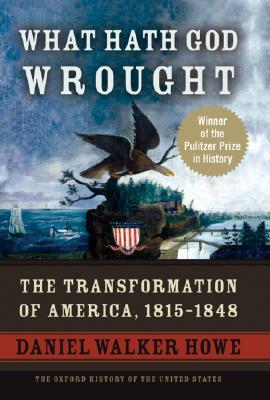
What Hath God Wrought by Daniel Walker Howe


The phrase “What Hath God Wrought” was the first message sent long distance over the telegraph. This was in some ways the beginning of the communications age. This book covers the period from 1815 to 1848. Many viewed the War of 1812 as the second American Revolution. In the aftermath of that war the American nation began to grow quickly. By the end of the period another war would be fought. This one with Mexico. That war would complete what we today call the Continental United States.

This period is rich in American history. The nation grew in size, but also in many other areas. Religion flourished in many new and differing ways. An American culture began to grow in the areas of science, literature, and the arts. The tasks of governing a Republic of vast proportions was a novel concept and continued to perplex many leaders. This period saw the end of the Federalist party with the government becoming a one party system with the Republican party in control during the Monroe years. After that the Republican party split itself in two as the followers of Andrew Jackson created the Democrat party and the opponents of Jackson creating the Whig party. Some of the greatest orators and politicians of 19th century America lived and served in this time. It was the period of Jackson, Henry Clay, Daniel Webster, John Calhoun, and John Quincy Adams. Towards the end of the period new leaders like Abraham Lincoln and Stephen Douglas began to rise.

Slavery was the elephant in the room that could no longer be ignored. As abolitionist societies began to grow in the North the Southern planter class become more and more adamant about protecting slavery. This conflict would continue to pull at the fabric of the nation until, a dozen years after the final period of this book, it would tear the nation in two.

These are only a few of the areas covered by Daniel Walker Howe in this outstanding volume in the Oxford History of the United States. Even a seasoned reader of history is bound to discover some new gems in these pages. Howe’s prose is never wooded and the subject is made very accessible. With magnificent books like these it is a shame that so few Americans read history. This is a great place to begin the study of a crucial time in our nation’s history.

Thursday, May 9, 2013

Empire of Liberty by Gordon Wood


The excellent volume in the Oxford History of the United States covers the period from the creation of the Constitution through the War of 1812. This 26 year period saw many changes take place in the United States. During this time George Washington served as President and helped to define that office. The first three presidents managed to keep the United States out of the wars that defined and tore Europe apart for over 25 years. Under Thomas Jefferson the nation doubled in size with the Louisiana Purchase. Advances were made in science, literature, religion, law, and politics. Few realize how important these years were. During this time an experiment in governing a large number of people spread out over a vast territory with a representational government. 

Gordon Wood is an excellent historian and this volume is proof that he is a great writer. The book covers a great deal of material, but never comes across as a dry academic text. The various sections give a great overview of the period and the people. The book is organized along topics more than a strict timeline, though the topics do follow a chronological order. The chapters on the Judiciary and on Religion were very good and quite balanced. There is a lot of helpful information that many Americans would do well to learn. This is a book that every American ought to read. 

Tuesday, May 7, 2013

The Glorious Cause by Robert Middlekauff

The Glorious Cause is a part of the Oxford History of the United States. It was a finalist for the Pulitzer Prize. It is one of the best one volume books on the period from 1754-1789. The complexity of events during this period are nothing less than daunting. The colonists fought a nine year war on behalf of the British Empire. Their loyalty to the crown was unquestioned. In a series of laws after the 1763, changed all of that. As the British Parliament began to assert itself the freedom loving American began to push back. Accustomed to representational government and a certain amount of autonomy, many colonists began to resist. By 1775, only a dozen years after the end of the French and Indian War, the resistance erupted into full rebellion.

Over the next eight years the new American Nation would fight for her independence against the greatest army and navy in the world. The Peace of Paris ended the war, but not the trouble in America. The weak nature of the Articles of Confederation meant that there was no way to maintain a strong national government. The solution for some was to create a new government. To this end the Constitution was written.

This book gives an excellent overview of this period. All of the major events are touched on. The size of the book means that not every topic can be dealt with in depth, but it gives readers a starting point. Middlekauff’s prose is not academic in nature and is very accessible to the average reader. Read this along with Gordon Woods’ Empire of Liberty and Daniel Walker Howe’s What Hath God Wrought and you will have a very strong foundation in American History.

Sunday, May 5, 2013

American Creation by Joseph Ellis


With Founding Brothers Ellis gave us a fascinating overview of the early years of the American Republic by focusing on several episodes that were key in the founding years.  In American Creation he returns to this format to tell six more interesting episodes in the founding of the United States. This time he goes back to the Revolution to begin the book. The first chapter covers the year 1776 and the writing of the Declaration of Independence. The second chapter jumps forward a year and looks at the American army at winter quarters in Valley Forge. Here in Valley Forge the leaders of the American Army came to an understanding of what it meant to be a unified force. This helps to explain why so many of those who worked to make a stronger national government were former officers in the army. In chapter three he examines the arguments surrounding the creation and ratification of the Constitution.

The first half of the book covers episodes that deal with the creation of the nation. The second half looks at three key episodes in the early years of the Republic. In chapter four Ellis examines the issue of how the Native Americans were treated in the early years of the Republic. We see how Washington and Knox sought to come up with some arrangement that could protect the natives and allow room for settlement. The futility of any agreement becomes apparent. There is simply no way to keep settlers out of Indian territory.  The last two chapters focus largely on Jefferson. Chapter five discusses the formation of the first American political party by Jefferson and Madison. The last chapter examines the Louisiana Purchase and how Jefferson dealt with what he saw as Constitutional issues.

This book feels a little more random at times than Founding Brothers. Each episode does work towards the central theme of the creation of the American system. Ellis is a great writer and this book makes a great introduction to the subject and to the episodes. Read this along with Founding Brothers and you will have a great start towards understanding the formation of the United States of America.

Thursday, May 2, 2013

Founding Brothers by Joseph Ellis


The Revolutionary Generation is filled with men and women who sometimes attain a semi-divine status. Mythologies have sprung up around our founders that sometimes make it hard to see these great figures as human. In the last century historians seemed to take an iconoclastic pleasure in trying to tear down these images. More recently a group of historians have come to the front on by finding a middle ground. Writers like David McCullough, Joseph Ellis, Jon Meacham, and others recognize that their subjects are human, but they also recognize that these humans accomplished great things and should be respected for their greatness.

This volume is not a history of those Founding Brothers or of the young nation. Instead it is a series of segmented stories that look at certain key moments in the lives of these men. The episodes serve to show how the United States was brought into being by these men. They had different ideas of what the United States meant. The genius of this story is not that one set of ideas prevailed, but rather that differing visions could work alongside and in competition. That is the genius of the United States. The ability to dialogue about what it means to be a nation of liberty.

There are so many great men featured here. Washington, Adams, Jefferson, Madison, Hamilton, and a cast of others. This is an excellent book for anyone wanting to learn more about the crafting of the United States.

- Posted using BlogPress from my iPad