Showing posts with label American History. Show all posts

Tuesday, January 8, 2019

John Marshall by Richard Brookhiser


John Marshall is one of the most consequential figures in the history of the United States, yet too little is known about him. In John Marshall : The Man Who Made The Supreme Court, journalist and author Richard Brookhiser seeks to help us know more about this man. In life Marshall was an unimposing character. Early in the book Brookhiser relates a story about Marshall at home in Richmond. He was dressed like any other rustic. A newcomer to town asked him to carry a turkey home from the market, not realizing until afterwards that he had used the Chief Justice of the Supreme Court as a delivery man. Marshall was a man of humor.  Brookhiser shares another anecdote in the book. The Justices would board in the same house when the Court was in session and they ate together. They established a custom that they could only have wine if it was raining. “Marshall would ask ‘Brother Story’ [Justice Joseph Story] to look out the window and say what the weather was. If Story reported that the sun was shining, Marshall would answer, ‘our jurisdiction extends over so large a territory…that it must be raining somewhere.’” 

These anecdotes help to remind us that Marshall was an approachable and affable man. That did not make him weak. In his Introduction Brookhiser points out that “When Marshall died in 1835, he and the Court he led had rebuked two presidents, Congress, and a dozen states and laid down principles of law and politics that still apply.” That, of course, is why we know Marshall. He was the man who turned the Supreme Court into a powerful part of the United States government. Before Marshall the Supreme Court had little influence on the nation. After Marshall the influence was powerful.

The book is well written and easily approachable by the general reader. Brookhiser is a journalist by training and profession so he does not get into the weeds of trying to explain all of the minutiae behind the laws. Instead he focuses on the political implications of Marshall’s rulings. This is important because when Marshall established the idea of judicial oversight he inserted the Court into the politics of the new nation. Marshall was well aware that he was helping to guide the nation forward. He was a Revolutionary War veteran who had served on Washington’s staff.  As a young member of the Virginia Ratifying Convention he fought hard alongside James Madison for the ratification of the Constitution.  He was a successful attorney in private practice before moving into the government. He served under John Adams as Secretary of State before he became the third Chief Justice. Brookhiser takes us through his early years without succumbing that siren call of the historian: the rabbit trail. So many writers feel a need to set up a history by giving huge back stories or going off into minute detail about some side issue. Brookhiser deftly gives us what we need to understand the subject and keeps moving.

This is an excellent book and does justice to the subject. It also delivers the reader a well written, informative, and enjoyable experience.


Tuesday, October 10, 2017

John Marshall by Harlow Giles Unger

John Marshall: The Chief Justice Who Saved The Nation
Harlow Giles Unger
Da Capo Press, 2014

John Marshall is one of the most important figures in American History, yet so few people know anything about him. Born in a log cabin in what was then the western frontier of the colony of Virginia he would rise until he became the Chief Justice of the Supreme Court. Marshall was far more than a mere Chief Justice. During his tenure on the court from 1801 – 1835 he would reinvent the Court and make it the powerful institution that it is today. In Marbury v. Madison, Marshall would assert the power of the Court to determine the constitutionality of a law passed by Congress. This particular duty of the Supreme Court is so taken for granted today that we forget how controversial it was at the time. President Thomas Jefferson, who did not want an independent judiciary, did his best to undermine and destroy the power of the Court. The Speaker of the House was a staunch Jefferson supporter and led the charge to impeach Samuel Chase, one of the Justices. The hope was to impeach and remove the judges who disagreed with Jefferson one by one until the Court was packed with Jefferson supporters who would then undermine the power of the Court. The trial of Justice Chase came back with a “not guilty” verdict and Jefferson was handed a strong defeat. After this Marshall and the Court would go on to carve out and define the power of the Court and establish precedents that exist to this day.


Florence King once referred to Harlow Giles Unger as “America’s most readable historian.” John Marshall proves once again that Mr. Unger has not lost any of those skills. This volume is not a reference heavy tome meant for the professional historian. It is an excellent introduction to both John Marshall and his world. You do not need any outside knowledge to understand this book and what is going on throughout this time period. Unger does not delve deeply into the side characters so if you want to know more about men like James Monroe, James Madison, and others then you will need to read about them. Fortunately, there are many excellent books on those sources. Unger is dedicated to his own subject and he does not fall prey to that Siren song that so often entraps the historian: the rabbit trail. This book is recommended for anyone who would like to know more about the history of the United States and the foundation period when so much that we take for granted today came about. Marshall is a fascinating subject and Unger brings him to life. We see the man willing to disappoint President Washington and turn down important government posts because of family duties. We see a man willing to stand up to Thomas Jefferson and fight for the right to an independent judiciary. Captain, Congressman, Secretary of State, Chief Justice of the Supreme Court are all official titles that he held from the period of the Revolution until his death in 1835. Those who knew him knew him as a son, husband, father, friend, patriot, a tireless worker for the new Union. Harlow Giles Unger shows us all of these aspects and gives us John Marshall.

Wednesday, June 12, 2013

Training Ground by Martin Dugard


Grant, Sherman, Lee, Longstreet. These are all names familiar to people who have studied the CIvil War. These were the men who fought each other in the most devastating war in United States History. In Training Ground Martin Dugard reminds us that these men were not always enemies. In the war with Mexico these men and many others fought side by side. Training Ground is not a full history of the Mexican War, it is more of a history of the men who fought the war together as young officers and would later command opposing armies. Dugard traces the early biographies of US Grant, James Longstreet, William Sherman, and Robert E. Lee. We see how these men went to West Point and entered into an army that promised very little in the way of a career and promotion.

The primary character in the story is a young US Grant. Each chapter is introduced with a quotation from Grant’s Memoirs. In his later life Grant was highly critical of the actions of the US Government in both provoking a war and then in the way that the Democratic leadership sought to run the war in a highly politicized manner. Of course the young Grant that we meet in these pages is less concerned with the political implication of the war. He is far more interested in getting back home to his love Julia. 

The Mexican War was indeed the Training Ground for the Civil War. If you are familiar with the history of the Civil War you can’t help but feel a little sad as you read this book. You know the history of these young, anxious, promising young officers. You know how they will end up opposing each other. Reading this book I couldn’t help but wonder what the US Army would have looked like had the Civil War not occurred. What would have happened if an army commanded by Lee with Grant, Longstreet, Jackson, Sherman, and the others have been able to do. With that much brilliance they could have stood against any army in the world. Instead they were forced by political forces to fight each other.

Training Ground gives a good overview of the Mexican War. It also gives an insight to men who would shape history only thirteen years later. This is something that a lover of American History or the Civil War should enjoy.

Friday, May 31, 2013

Wicked River: The Mississippi When It Last Ran Wild by Lee Sandlin


Old Man River. The Father of Waters. The Big Muddy. These are all names that are used for the great river of North America: The Mississippi. The Mississippi River has been an important part of the history, literature, commerce, and myth of the United States for generations. At the end of the War of Independence it became the western boundary of the United States. The navigation of the river was vital to the settlers who moved west of the Allegheny Mountains after the war. After the Louisiana Purchase the Mississippi became the most important waterway in the United States. It was used to move manufactured goods and produce. To move these goods a hardy breed of person was needed. The men and women who worked, travelled, and lived on and along the river river a hardy and wild lot.

Wicked River tells the story of these rowdy people. Perhaps I should say that it tells the stories of the the river people. The book is not really arranged as a continuous narrative, but rather tells a number of different stories about people and events along the river.  The Mississippi River is known to many as the setting of classic Mark Twain stories like Tom Sawyer and Huckleberry Finn. Sandlin starts off with a disadvantage. In the opening of the book he relates his own ignorance of Twain and seems to be almost proud of the fact. This seems odd in a writer who has chosen the Mississippi as his subject. Even more strange is that he didn’t re-read Twain for this project. It is a pity because many of the stories that he relates and many of the character types that he discusses can be seen throughout Twain’s books. In fact if you first read Twain this book will be a little more fun.

Sandlin is a good writer and he does seem to enjoy his subject. He relates stories of river pirates, bandits, rogues, and murderers. The river was a deadly place. He also shares stories about those who settled along the river. The Mississippi seemed to have a very violent culture. I learned some interesting things about the river I did not know. I have lived near the Mississippi for much of my life, yet I did not know that the temperature of the river in the current never gets much above 40 degrees. Anyone falling into the river will not last long before hypothermia kicks in. I was also fascinated by the stories of some of the river pirates. I was reminded of an old Davy Crockett video my grandmother bought me when I was a kid. I was also intrigued by the stories of frontier justice. The lynching courts, the swift and brutal justice, these were aspects of river life I had not read about before.

Wicked RIver is not a great book. It is a good book and it covers a fascinating period in American history. Even a history lover like myself can find new and wonderful stories.

Friday, May 24, 2013

All the Great Prizes by John Taliaferro


John Hay is one of the most important individual to ever hold the office of Secretary of State. He spent a lifetime serving his nation. In All The Great Prizes John Taliaferro traces the life of this fascinating man. After finishing at Brown Hay went to work for his uncle’s law office in Springfield, Illinois. The office next door was occupied by Abraham Lincoln. Hay was hired as one of Lincoln’s secretary during the campaign. The other secretary, John Nicolay, was a friend from Hay’s teenage years.

After Lincoln’s election Hay and Nicolay accompanied Lincoln to Washington. They lived in the White House and served Lincoln until his death. Taliaferro gives a lot of time to this parr of Hay’s life. The stories about Lincoln are really great. Hay saw him as a person and so the intimate look at Lincoln was very moving. Taliaferro also mentions the troubles that the secretaries had with Mary Lincoln, who hated them both. Hay become friends with Robert Lincoln, the President’s oldest son, and they two of them were together when they were summoned to the dying president’s bedside.

Hay’s story continues after Lincoln’s He served as secretary to the legation in Paris for a year, then he was sent as a temporary head of the legation to Austria. While in Austria he saw the dangers inherent of crumbling empires bolstering themselves up with large armies.“The great calamity and danger of Europe today are those enormous armaments,” he observed. “No honest statesman can say that he sees in the present attitude of politics the necessity of war. No great Power is threatened.  .  .  . Why then is the awful waste of youth and treasure continued? I believe from no other motive than to sustain the waning prestige of Kings.” This would continue until it resulted in the First World War.

Taliaferro gives us a wonderful insight into the man. Hay was a gregarious person with an elitist personality. Among his friends were men such as Henry Adams and Henry James. Hay was an author of some note. He wrote a few novels and poems, not all good, but some were considered classics. Along with John Nicolay he published a ten volume biography of Abraham Lincoln. Hay’s personal life is quite interesting. He seemed to have several affairs of the heart, though they were unlikely consummated, with some intriguing women.

When it comes to the last decade of his life Taliaferro shows how Hay worked ceaselessly to avoid war. Hay’s nature was not aggressive but congenial. He preferred to work out deals that helped to keep the peace. Hay had spent the early days of his political career watching the Civil War and never wanted to see war on that scale again. We see the amazing work that Hay did for William McKinley and Teddy Roosevelt.

All the Great Prizes is a well written book. I was amazed at how much information is contained in these pages, yet the writing is never dry. Hay was truly one of the greatest statesmen ever to serve the United States of America. Taliaferro has given us an excellent book on a fascinating subject. Do yourself a favor and pick up this book.

Tuesday, May 21, 2013

Lion of Liberty by Harlow Giles Unger


Patrick Henry is one of those characters in history that many people know his name, but know little about him. Many are familiar with the line from his famous speech where he declared "Give me liberty or give me death." Few know much more about him. Harlow Giles Unger has set out to change that. In the past Unger has written about James Monroe and John Quincy Adams. In this book he turns his attention to Patrick Henry. Henry was not like a lot of his Virginia colleagues. He was not born to a wealthy planter. After failing at a few business ventures he finally took up the study of law. Before long he had established himself as a well respected attorney. Henry's strong appeal was his common sense and his love of liberty. He was a radical long before it was popular.

He was married twice. He had six children with his first wife and twelve more with his second. Many in his own time joked that he was the true father of his country. Henry was a man who believed in personal liberty. The belief was so strong that he opposed the ratification of the Constitution. Like many in his age he feared the dangers that a strong national government posed. He particularly feared the lack of a Bill of Rights in the Constitution. He was not happy that the Constitution was ratified, but he refused to oppose the new government.

Unger is an entertaining writer. If he has one major flaw it is to take the side of his subject a little too freely. In his biography of Monroe he felt the need to downplay the importance of John Quincy Adams. In his biography of Adams he builds him up as being incredibly important. One glaring example stuck out in this book. When Edmund Randolph and Thomas Jefferson gave their approval of the Constitution, despite serious reservations, Unger implies not only that Henry thought that there was a conspiracy between these men and Washington, but also that such a theory might have credence. It is absurd to imply that George Washington bribed Randolph and Jefferson with cabinet positions. No evidence is given, just a random thought thrown out. The occasional lapse aside Unger is a good writer, if a bit on the enthusiastic. There are so few books on this important founder that it is well worth checking this book out.

Sunday, May 19, 2013

His Excellency: George Washington by Joseph Ellis

There is little doubt that the most important historical figure in the United States is George Washington. This was recognized in his own time and remains true today. Born to a Virginia planter he went on to become a war hero, wealthy landowner, representative, a war hero again, and the first President of the United States. Any study of Washington has to take his character into consideration. After all, few men in a position of such power have ever been able to surrender that power and walk in to retirement.

Joseph Ellis is a prolific writer on the Revolutionary generation. He has won numerous awards including the Pulitzer Prize. He is also one of the most readable writer of history. This biography is not as in depth as larger works like Ron Chernow's Washington: A Life. Of course at one third the size of that larger work one has to expect a more cursory look at many aspects of Washington. Ellis does do an excellent job of presenting a full biography of his subject. Washington comes through on these pages as an extraordinary man, which he was. Ellis is not above criticizing Washington when he made mistakes, but he also recognizes that Washington learned from those mistakes and always seemed to come out better for them.

This is an excellent book and a wonderful introduction to the life of George Washington. You won't regret reading this book.


- Posted using BlogPress from my iPad

Wednesday, May 15, 2013

Bunker Hill by Nathaniel Philbrick


The Battle of Bunker Hill. Most Americans have heard of this famous battle. June 17, 1775, the British forces led by General William Howe attacked the newly fortified Colonial position on Breed’s Hill and were repulsed on the first two attempts. On the third attempt the Colonial forces were finally forced to pull back due to lack of powder. The battle was not a large battle, fewer than 6,000 soldiers were involved. This would have been considered barely a skirmish in Europe. Yet this fight lives on in American legend.

Nathaniel Philbrick turns his talent to the story of this famous battle. He starts the book well before the events of that fateful day. He recounts the struggles between the colonial population and the British government over issues such as taxation. He gives a lot of detail about the nature and use of mob violence in colonial world. Philbrick spends a lot of time on this subject. He paints a rather terrifying spectacle of these mobs. One of the stories he relates is of an outspoken supporter of government policy who is taken from his home, dragged through the town, tarred, feathered, beaten, and almost hanged before the crowd is through with him.

There are two prominent characters in this book that we don’t hear enough about today: Joseph Warren and Samuel Adams. These were the two primary leaders in the anti-government movement. Samuel Adams, the elder of the two was a well known rabble rouser. He understood how to work the crowds and to use every situation to his advantage. Joseph Warren was one of the most respected physicians in Boston. He was also dedicated to the cause of liberty. He was, by all accounts, a great orator and a tireless worker on behalf of the cause. Philbrick spends a lot of time speculating as to whether he fathered a child by a maid. This may be the weakest part of the book. It really doesn’t matter whether or not Warren fathered this child and it does nothing to tell the story.

A good amount of the book deals with the lead up to the British march on Lexington and Concord, and with the actual fights on that April day. I was not aware of the British atrocities committed on the retreat to Boston until I read this book. Many of the dead Americans were civilians who were simply murdered by the British who were enraged over being forced to retreat.

Philbrick spends a lot of time on the battle itself. The main part of the battle was actually fought on Breed’s Hill, not Bunker Hill. The colonial forces were supposed to fortify Bunker Hill, but went to far forward and dug in to a less defensible position on Breed’s Hill. The British success drove the colonial forces off of Breed’s Hill and then Bunker Hill. It was in the defense of Breed’s Hill that Joseph Warren has killed. His loss was felt strongly by all who knew him.

Philbrick is a very good writer and knows how to keep the narrative flowing. He has found a lot of interesting stories and a lot of interesting characters. This is an easy to read, enjoyable book that can read with little or no background knowledge of the subject.

Patriotic Fire by Winston Groom

The Battle of New Orleans is a strange battle to discuss. It was the last battle in the War of 1812. It was fought after the war had actually ended. Since transportation was so slow the news of the war’s end did not arrive in time to prevent the battle. One one side were the invaders. General Packinham led an army of battle hardened British soldiers. Many of them had campaigned against the French armies in Portugal, Spain, and France with the Duke of Wellington. They were not an army used to defeat. Against that force was General Andrew Jackson of Tennessee. Jackson had assembled a motley crew of Louisiana, Tennessee, and Kentucky volunteers, US Army regulars, Baratarian pirates, and Choctaw warriors. When on January 8, 1815 the 11,000 man British force attacked it was repulsed with heavy losses by the Americans.

Winston Groom, best known as author of Forrest Gump takes the reader on a fascinating ride through the story of this war. Groom introduces the conflict by discussing an ancestor of his who fought at the battle. Then he gives a long background on the history of Jean Laffite and his Baratarians. He discusses the city of New Orleans, the background of the war, Andrew Jackson, and a host of other things. Groom is a brilliant author and his prose really shines forth in this book. He doesn’t pretend to be a professional historian. Where the records are confusing or contradictory, which is often, he gives several possibilities and then shares which one he like best. This is a great book about a fascinating battle. Do yourself a favor and read this.

Tuesday, May 14, 2013

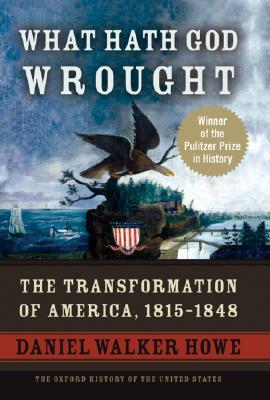
What Hath God Wrought by Daniel Walker Howe


The phrase “What Hath God Wrought” was the first message sent long distance over the telegraph. This was in some ways the beginning of the communications age. This book covers the period from 1815 to 1848. Many viewed the War of 1812 as the second American Revolution. In the aftermath of that war the American nation began to grow quickly. By the end of the period another war would be fought. This one with Mexico. That war would complete what we today call the Continental United States.

This period is rich in American history. The nation grew in size, but also in many other areas. Religion flourished in many new and differing ways. An American culture began to grow in the areas of science, literature, and the arts. The tasks of governing a Republic of vast proportions was a novel concept and continued to perplex many leaders. This period saw the end of the Federalist party with the government becoming a one party system with the Republican party in control during the Monroe years. After that the Republican party split itself in two as the followers of Andrew Jackson created the Democrat party and the opponents of Jackson creating the Whig party. Some of the greatest orators and politicians of 19th century America lived and served in this time. It was the period of Jackson, Henry Clay, Daniel Webster, John Calhoun, and John Quincy Adams. Towards the end of the period new leaders like Abraham Lincoln and Stephen Douglas began to rise.

Slavery was the elephant in the room that could no longer be ignored. As abolitionist societies began to grow in the North the Southern planter class become more and more adamant about protecting slavery. This conflict would continue to pull at the fabric of the nation until, a dozen years after the final period of this book, it would tear the nation in two.

These are only a few of the areas covered by Daniel Walker Howe in this outstanding volume in the Oxford History of the United States. Even a seasoned reader of history is bound to discover some new gems in these pages. Howe’s prose is never wooded and the subject is made very accessible. With magnificent books like these it is a shame that so few Americans read history. This is a great place to begin the study of a crucial time in our nation’s history.

Thursday, May 9, 2013

Empire of Liberty by Gordon Wood


The excellent volume in the Oxford History of the United States covers the period from the creation of the Constitution through the War of 1812. This 26 year period saw many changes take place in the United States. During this time George Washington served as President and helped to define that office. The first three presidents managed to keep the United States out of the wars that defined and tore Europe apart for over 25 years. Under Thomas Jefferson the nation doubled in size with the Louisiana Purchase. Advances were made in science, literature, religion, law, and politics. Few realize how important these years were. During this time an experiment in governing a large number of people spread out over a vast territory with a representational government. 

Gordon Wood is an excellent historian and this volume is proof that he is a great writer. The book covers a great deal of material, but never comes across as a dry academic text. The various sections give a great overview of the period and the people. The book is organized along topics more than a strict timeline, though the topics do follow a chronological order. The chapters on the Judiciary and on Religion were very good and quite balanced. There is a lot of helpful information that many Americans would do well to learn. This is a book that every American ought to read. 

Tuesday, May 7, 2013

The Glorious Cause by Robert Middlekauff

The Glorious Cause is a part of the Oxford History of the United States. It was a finalist for the Pulitzer Prize. It is one of the best one volume books on the period from 1754-1789. The complexity of events during this period are nothing less than daunting. The colonists fought a nine year war on behalf of the British Empire. Their loyalty to the crown was unquestioned. In a series of laws after the 1763, changed all of that. As the British Parliament began to assert itself the freedom loving American began to push back. Accustomed to representational government and a certain amount of autonomy, many colonists began to resist. By 1775, only a dozen years after the end of the French and Indian War, the resistance erupted into full rebellion.

Over the next eight years the new American Nation would fight for her independence against the greatest army and navy in the world. The Peace of Paris ended the war, but not the trouble in America. The weak nature of the Articles of Confederation meant that there was no way to maintain a strong national government. The solution for some was to create a new government. To this end the Constitution was written.

This book gives an excellent overview of this period. All of the major events are touched on. The size of the book means that not every topic can be dealt with in depth, but it gives readers a starting point. Middlekauff’s prose is not academic in nature and is very accessible to the average reader. Read this along with Gordon Woods’ Empire of Liberty and Daniel Walker Howe’s What Hath God Wrought and you will have a very strong foundation in American History.

Sunday, May 5, 2013

American Creation by Joseph Ellis


With Founding Brothers Ellis gave us a fascinating overview of the early years of the American Republic by focusing on several episodes that were key in the founding years.  In American Creation he returns to this format to tell six more interesting episodes in the founding of the United States. This time he goes back to the Revolution to begin the book. The first chapter covers the year 1776 and the writing of the Declaration of Independence. The second chapter jumps forward a year and looks at the American army at winter quarters in Valley Forge. Here in Valley Forge the leaders of the American Army came to an understanding of what it meant to be a unified force. This helps to explain why so many of those who worked to make a stronger national government were former officers in the army. In chapter three he examines the arguments surrounding the creation and ratification of the Constitution.

The first half of the book covers episodes that deal with the creation of the nation. The second half looks at three key episodes in the early years of the Republic. In chapter four Ellis examines the issue of how the Native Americans were treated in the early years of the Republic. We see how Washington and Knox sought to come up with some arrangement that could protect the natives and allow room for settlement. The futility of any agreement becomes apparent. There is simply no way to keep settlers out of Indian territory.  The last two chapters focus largely on Jefferson. Chapter five discusses the formation of the first American political party by Jefferson and Madison. The last chapter examines the Louisiana Purchase and how Jefferson dealt with what he saw as Constitutional issues.

This book feels a little more random at times than Founding Brothers. Each episode does work towards the central theme of the creation of the American system. Ellis is a great writer and this book makes a great introduction to the subject and to the episodes. Read this along with Founding Brothers and you will have a great start towards understanding the formation of the United States of America.

Thursday, May 2, 2013

Founding Brothers by Joseph Ellis


The Revolutionary Generation is filled with men and women who sometimes attain a semi-divine status. Mythologies have sprung up around our founders that sometimes make it hard to see these great figures as human. In the last century historians seemed to take an iconoclastic pleasure in trying to tear down these images. More recently a group of historians have come to the front on by finding a middle ground. Writers like David McCullough, Joseph Ellis, Jon Meacham, and others recognize that their subjects are human, but they also recognize that these humans accomplished great things and should be respected for their greatness.

This volume is not a history of those Founding Brothers or of the young nation. Instead it is a series of segmented stories that look at certain key moments in the lives of these men. The episodes serve to show how the United States was brought into being by these men. They had different ideas of what the United States meant. The genius of this story is not that one set of ideas prevailed, but rather that differing visions could work alongside and in competition. That is the genius of the United States. The ability to dialogue about what it means to be a nation of liberty.

There are so many great men featured here. Washington, Adams, Jefferson, Madison, Hamilton, and a cast of others. This is an excellent book for anyone wanting to learn more about the crafting of the United States.

- Posted using BlogPress from my iPad

Monday, April 29, 2013

American Gospel by Jon Meacham


The issue of religion, both public and private, has had a place in the United States ever since our founding. Jon Meacham brings a historian's eye to this interesting and complex issue. The men who founded the United States came from diverse backgrounds, yet they had many things in common. Meacham shows that the ethics and morality of the Bible have informed and defined the history of the United States from the beginning.

Religion informs the way that we discuss issues and forms our public lives as well as our private lives. Jefferson used religious imagery when writing the Declaration of Independence. Abolitionists used the gospel to fight slavery. The issue was not couched in economic terms, but in the terms of a system that was evil in its nature. Franklin Roosevelt believed that the New Deal was a Christian imperative to help the poor. Martin Luther King, Jr. couched the Civil Rights movement not as a political movement, but as a spiritual movement.

This is an issue that still divides our nation today. This book will help to set the stage for understanding the complex ways that religion in general and the Christian religion in particular still defines how we talk about political and social issues. Both liberals and conservatives will take issue with different points of this book, but maybe that's a good thing. Whether or not you agree with every point you will find a lot to think about with this book.


- Posted using BlogPress from my iPad